Smoke preparedness · Backup power
A purifier needs enough clean-air delivery for its room. A battery needs enough usable energy to keep that purifier running. This guide connects those two decisions, with calculations you can reproduce before choosing equipment.
Calculation review: 31 August 2026. The tables use illustrative loads, not tests of named products. No manufacturer has sponsored these calculations.
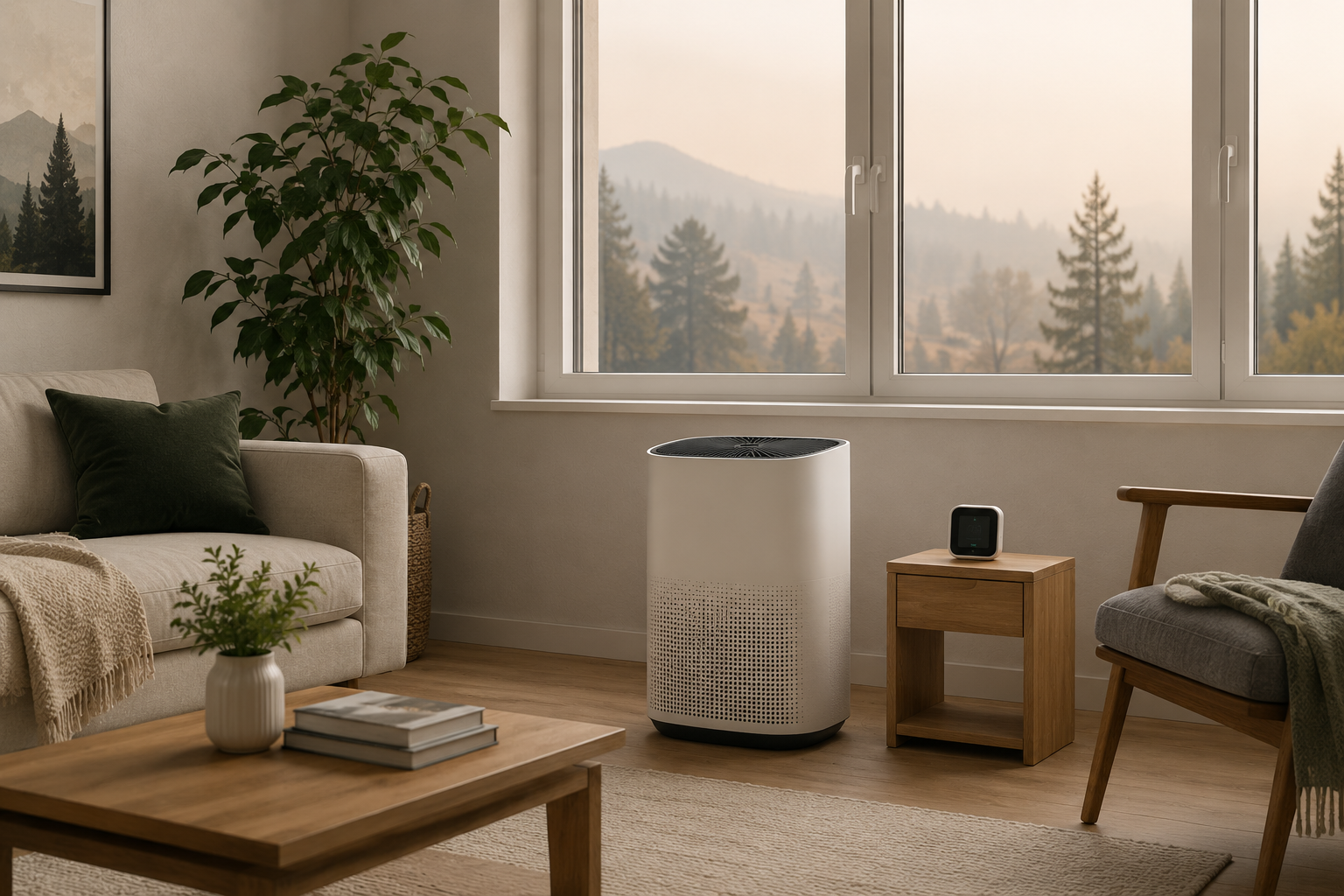
Safety comes first. A charged battery does not make a home safe to occupy. Follow evacuation instructions. EPA guidance advises considering shelter elsewhere if a home cannot stay cool, loses electricity or still admits too much smoke. Filtration runtime is not a safe-exposure limit.
Start with clean-air delivery, then measure watts
Do not choose a low-power setting simply because it produces an attractive battery-runtime number. A purifier’s advertised smoke CADR generally describes its highest setting; lower fan speeds may deliver substantially less clean air. EPA recommends a correctly sized portable air cleaner and continuous operation at the highest setting when possible. See the clean-room guidance and our CADR calculator.
- Define the room and filtration requirement. Check smoke CADR, room dimensions and the actual fan setting.
- Check the purifier’s electrical rating. Voltage, frequency and input requirements must match the power station’s output. A plug adapter alone does not resolve a voltage mismatch.
- Measure the load if possible. Use a compatible plug-in energy meter at the intended setting. If the purifier changes speed, measure energy over a representative period rather than relying on one instantaneous reading.
- Add the other equipment. Include lights, communications equipment and anything else sharing the battery. The tables below exclude those additional loads.
Watts (W) describe power demand; watt-hours (Wh) describe stored or consumed energy. A 2,000 W output rating does not mean that a battery contains 2,000 Wh. Likewise, a low wattage does not establish adequate smoke filtration.
Explore your own load: use the tool below to see how demand changes the runtime estimate.
How does electrical demand change runtime?
Move the demand slider and see the curve change. Enter watts directly, or calculate active power from current, voltage and power factor.
Enter at least two documented fuel-consumption points for the same generator and fuel. Blank fields are unknown. No generic fuel curve is assumed.
Interpolation is only between the entered points. No extrapolation beyond their load range; efficiency can vary with load and equipment conditions.
Measured watts are preferable to estimating from amperes.
Move across the curve to inspect another demand.
View the curve as a data table
| Demand (W) | Active power (W) | Runtime (h) |
|---|
Battery estimate: capacity × usable-capacity factor × efficiency × (1 − reserve) ÷ active load.
A fully charged battery and a constant load are assumed. Standby consumption, temperature, ageing and changing loads can reduce runtime. No solar input or other recharge is included.
Planning estimate, not a safety assessment. Check continuous output, surge and apparent-power limits separately. Do not use this tool for life-support equipment or to decide whether to remain in a building. Never operate a fuel-burning generator indoors or in a garage.
Plan several devices — battery sizing
Size a battery for your equipment list
Add up to 12 devices, their quantities, running watts and operating hours within your planning period. The result uses the battery capacity, usable-capacity factor, efficiency and reserve selected above.
Illustrative example, not product specifications: a 60 W air purifier and a 12 W router for 24 hours, plus an 8 W light for 6 hours. Replace every example with supported data for your own equipment.
| Equipment | Quantity | Running W each | Hours each | Delivered Wh |
|---|
This sets the battery graph to the combined running watts, as if all included devices ran continuously. The graph does not simulate their individual operating schedules.
Method: required nameplate Wh = planned delivered Wh ÷ (usable-capacity factor × conversion efficiency × remaining fraction after reserve). Available Wh = selected nameplate Wh × those factors.
This is an energy budget, not proof that equipment will operate safely or complete the schedule. Check continuous output, starting current, apparent power, voltage, temperature and low-load shutoff separately. Use realistic operating hours or measured energy for cycling equipment; do not count the same losses twice. No solar charging, inverter idle consumption or other recharge is included. Not for life-support equipment or evacuation decisions.
Calculator inputs are processed in your browser; this tool does not submit them.
Air purifier runtime by battery capacity
Each column below is an assumed constant load, not a measured purifier model or a recommended fan speed. The battery starts fully charged. We apply no additional usable-capacity derating, then allow 85% conversion efficiency and retain 10% of the battery energy as a reserve. That leaves 76.5% of nameplate capacity for this simplified estimate.
| Battery capacity | 30 W load | 60 W load | 90 W load |
|---|---|---|---|
| 512 Wh (0.512 kWh) | 13.1 h | 6.5 h | 4.4 h |
| 1,024 Wh (1.024 kWh) | 26.1 h | 13.1 h | 8.7 h |
| 2,048 Wh (2.048 kWh) | 52.2 h | 26.1 h | 17.4 h |
| 3,072 Wh (3.072 kWh) | 78.3 h | 39.2 h | 26.1 h |
Formula: runtime (hours) = battery capacity (Wh) × 0.85 × 0.90 ÷ load (W). For example: 1,024 × 0.85 × 0.90 ÷ 60 = 13.056 hours, or approximately 13 hours 3 minutes.
The efficiency assumption is not a universal product specification. Temperature, battery age, inverter idle demand, auto-shutoff and changing fan speed can reduce runtime. Percentage-based estimates can be especially optimistic at low loads. Solar input is excluded; do not assume that sunlight or safe outdoor access will be available during an outage.
What battery size covers 12 or 24 hours?
Reverse the calculation when you know the duration you want to plan for. These figures are the calculated nameplate-capacity requirement under the same assumptions, rounded upward to the next whole Wh. They are not recommended product sizes or guaranteed operating durations.
| Constant purifier load | 12-hour target | 24-hour target |
|---|---|---|
| 30 W | 471 Wh | 942 Wh |
| 60 W | 942 Wh | 1,883 Wh |
| 90 W | 1,412 Wh | 2,824 Wh |
A nominal 2 kWh battery is therefore a plausible starting point for investigating a 24-hour, 60 W requirement, but the margin in this example is small. Compare measured performance where available, include other loads and test your actual combination before relying on it.
Worked example: purifier, router and lighting
Consider a hypothetical 60 W purifier, 12 W router and 8 W light operating together continuously. Their combined load is 80 W. These values illustrate the method; measure your own devices.
- 24-hour energy demand: 80 W × 24 h = 1,920 Wh delivered to the equipment.
- Calculated battery requirement: 1,920 ÷ 0.765 ≈ 2,510 Wh of nameplate capacity, rounded upward.
- Runtime from a 2,048 Wh battery: 2,048 × 0.765 ÷ 80 ≈ 19.6 hours, not 24 hours.
This is why buying a battery from the purifier’s wattage alone can leave an outage plan short. If a device operates intermittently, use a realistic energy estimate for it; do not assume that every load runs all day.
Check compatibility before an outage
- Continuous output and startup: confirm the station supports the total running load and any startup requirement. Follow the purifier and power-station manuals.
- Low-load shutoff: check whether an energy-saving timer can turn off AC output while the purifier is running at a low setting.
- Pass-through and transfer time: do not assume every power station is an uninterruptible power supply. Check the manufacturer’s limits and verify that the purifier restarts as intended after a power interruption.
- Placement: keep the battery dry, respect ventilation and temperature limits, and keep exits clear. Do not use damaged batteries or improvised wiring.
- Recharge plan: check the available input, charging time and safe access. A battery that covers one night may not cover a multi-day outage without a dependable recharge route.
A battery power station and a fuel-burning generator are different devices. For fuel generators, CPSC guidance calls for outdoor operation at least 20 feet from homes, with exhaust directed away, and working CO alarms. Never operate a fuel generator indoors or in a garage, even with doors open. A particle purifier must not be relied on for protection from carbon monoxide.
Use the calculation to narrow your equipment shortlist
First identify the clean-air delivery you need at a usable fan setting. Then size the battery for that electrical load and your other essentials. The two comparisons below show published specifications and their limitations; neither is a substitute for testing your complete setup.
- Compare smoke CADR, published power and filtration criteria for air purifiers.
- Compare portable power-station capacity, output and charging specifications.
- Browse the wildfire-preparedness buying guides.
This guide is an educational calculation, not a hands-on review, safety certification or paid product ranking. Any affiliate relationship must be disclosed alongside the relevant links. See our Editorial Policy and Affiliate Disclosure.
Common questions
Can a 500 Wh battery run a purifier overnight?
It depends on the load and what “overnight” means. At 60 W, 500 × 0.765 ÷ 60 gives approximately 6.4 hours under this model, which is below an eight-hour target. An eight-hour, 60 W requirement works out at approximately 628 Wh of nameplate capacity before additional allowances.
Will switching to sleep mode make the battery last longer?
Lower electrical demand increases the calculated runtime, but may also reduce filtration substantially. Do not treat a long sleep-mode runtime as proof that the room receives enough clean air. Choose the operating setting from the filtration requirement, then plan its energy supply.
Can I run two air purifiers from one power station?
Add both electrical loads, include any other equipment, and check the station’s output and startup limits. Two steady 60 W purifiers create a 120 W load: a 2,048 Wh battery calculates to approximately 13.1 hours with the assumptions used here.
Does a “solar generator” keep running indefinitely?
No. That label commonly describes a battery station with solar charging capability. Runtime still depends on stored energy, actual solar input and the connected load. The tables deliberately assume no recharge; only count energy you can realistically and safely obtain.
Sources and calculation limits
- US EPA — Create a Clean Room to Protect Indoor Air Quality During a Wildfire. Supports the filtration, fan-setting and relocation cautions, not our battery-efficiency assumption.
- US CPSC — Carbon Monoxide Information Center. Supports the fuel-generator and CO precautions.
- Tecnobosque calculations: steady-load energy balance, 100% usable-capacity factor, 85% conversion efficiency, 10% reserve, no recharge. Assumptions are illustrative and should be replaced with measured or manufacturer-supported values for the intended setup.
This guide does not cover life-support equipment or determine whether remaining in a building is safe. Follow local emergency instructions and obtain equipment-specific professional advice where needed.