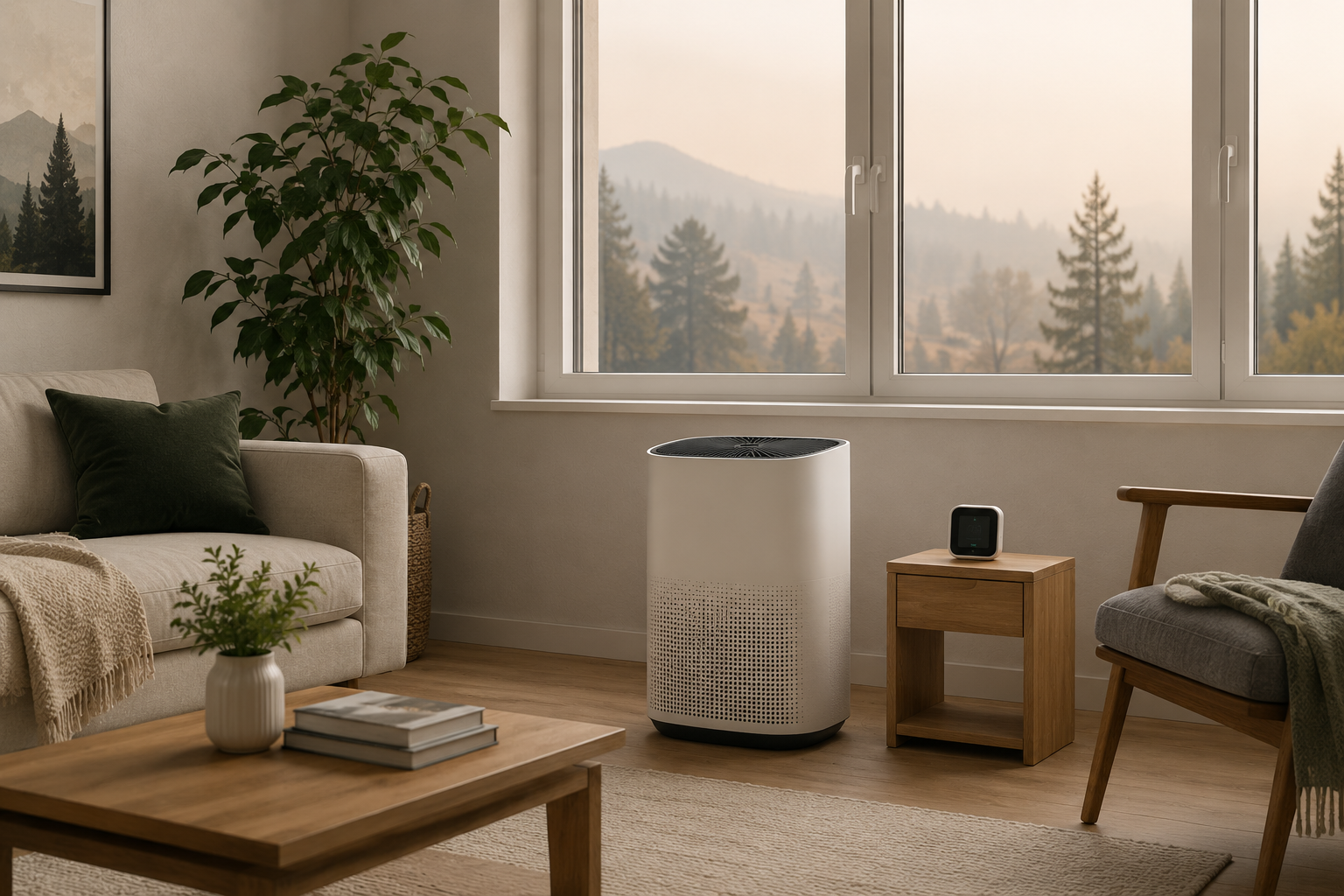
Understand the relationship between room volume, air changes, clean-air delivery, filtration and building leakage before choosing or sizing an air cleaner.
Indoor particle levels depend partly on how much outdoor smoke enters through leakage, doors and ventilation.
Cleaner-air planning begins with the volume of the space being treated, not only its floor area.
CADR describes filtered-air delivery and can be related to room volume through an air-change target.
Filter condition, fan speed, placement and room mixing affect real-world performance.
Closing windows does not make a building perfectly isolated. Outdoor smoke can still enter through leakage paths and ventilation, while indoor activities can create additional particles.
Wildfire smoke contains fine particles capable of entering buildings and remaining suspended in indoor air.
Cleaner-air planning therefore focuses on reducing entry where practical and continuously removing particles from the indoor air volume.
Two rooms with the same dimensions can behave differently because infiltration, ventilation, door opening and air distribution are different.
A calculated CADR is therefore a planning quantity rather than a guarantee of a particular indoor particle level.
Instead of attempting to treat an entire building, a defined room can concentrate filtration capacity within a smaller indoor volume.
Select a room that can be kept relatively closed from the rest of the building and where occupants can spend time during periods of smoke.
Measure room length, width and ceiling height so that the actual air volume can be estimated.
Then choose a target air-change rate and determine the clean-air delivery needed to support that target.
Doors, windows and other leakage paths still matter: filtration removes particles from indoor air but does not prevent outdoor smoke from entering.
CLEANER
CADR and ACH describe different things but can be connected through room volume.
For an imperial calculation, room volume V is expressed in cubic feet and CADR is returned in cubic feet per minute.
For example, a 15 × 12 × 8 ft room has a volume of 1,440 ft³.
At a target of 5 air changes per hour: 1,440 × 5 ÷ 60 = 120 cfm.
This is the base mathematical clean-air requirement before considering real-world uncertainties such as leakage, placement and performance at the selected fan setting.
Change room dimensions, target ACH and purifier capacity in real time. The dedicated calculator also converts between feet and metres and estimates purifier count.
Open Wildfire Smoke CADR Calculator →A simple example shows why room volume and target air-change rate are more useful for sizing than floor area alone.
A calculator provides a controlled estimate. Indoor conditions depend on the building, equipment and how the room is actually used.
Higher outdoor particle concentrations can increase the amount of smoke entering the building.
Air entering through cracks, doors and uncontrolled leakage adds new particles to the room.
Purifier airflow and CADR can change substantially between operating speeds.
Loading, maintenance and replacement condition can affect system performance.
Blocked intakes, obstructed outlets or poor positioning can reduce effective room mixing.
Cooking, candles and other indoor activities can add particles independently of wildfire smoke.
Airflow describes the volume of air moved by the device. It does not by itself describe how effectively particles are removed.
CADR is intended to represent the rate at which cleaner air is delivered after accounting for particle-removal performance under the relevant test conditions.
Tecnobosque’s interactive CADR calculator reports the base clean-air requirement from room volume and target ACH.
If a project later applies an additional allowance for uncertainty, that should be shown as a separate planning assumption rather than hidden inside the CADR equation.
For example, a base requirement of 120 cfm with a separately stated 20% planning allowance would correspond to a planning target of 144 cfm.
Calculate the room requirement first, then compare products around the relevant smoke CADR rather than starting from brand names alone.