Buying guide · Indoor air
Choosing an air purifier for wildfire smoke is mainly a sizing and maintenance decision. Focus on smoke CADR, low ozone emissions, replacement-filter cost and the room where the unit will operate.
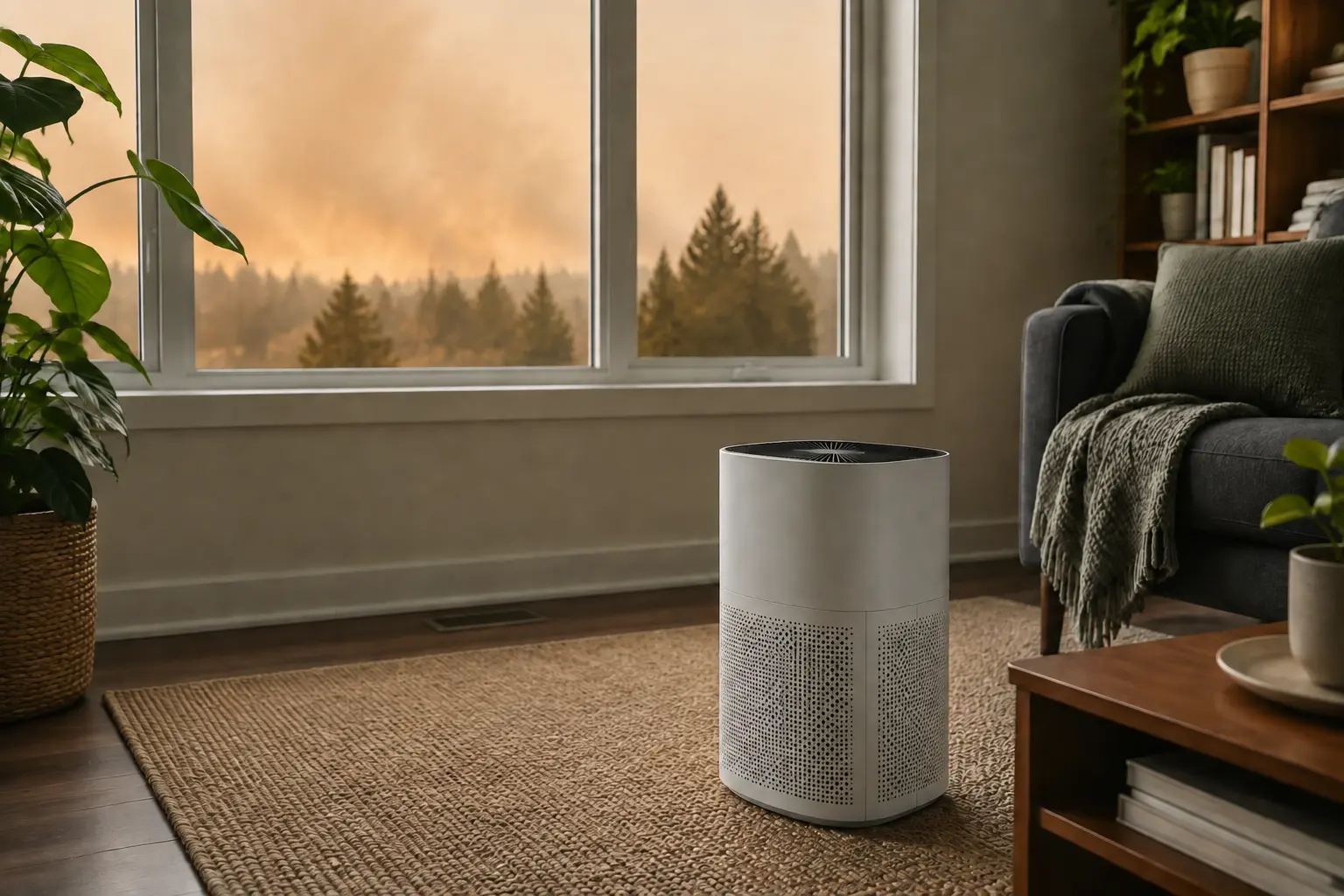
1. Size the purifier by smoke CADR
For heavy wildfire smoke, a practical planning target is a smoke CADR approximately equal to the room area in square feet. Higher ceilings, open layouts and leakage from outdoors may require additional capacity.
| Room area | Target smoke CADR |
|---|---|
| 100 sq ft | 100 cfm |
| 200 sq ft | 200 cfm |
| 300 sq ft | 300 cfm |
| 500 sq ft | 500 cfm |
The US EPA baseline sizing rule is a tobacco-smoke CADR of at least two-thirds of the room area for an eight-foot ceiling. AHAM recommends using a smoke CADR close to the full room area when wildfire smoke is severe. The stronger target used above adds useful planning margin for smoke events.
2. Check ozone and filtration
Look for a documented particle CADR and a HEPA or high-efficiency particle filter. Avoid devices that intentionally generate ozone. Activated carbon can help with some gases and odours, but CADR is a particle-removal rating and does not measure gas removal.
3. Compare the real operating cost
- Replacement-filter price and availability
- Noise at the setting you will actually use
- Electricity consumption during continuous operation
- Warranty and manufacturer support
- Ease of cleaning and filter replacement
4. One purifier or several?
For an open floor plan, calculate the connected area rather than a single room. Several correctly sized units can provide better coverage than one undersized unit. During heavy smoke, designate one cleaner-air room and keep doors and windows closed.
Use the Tecnobosque CADR calculator
Use our Cleaner-Air Room CADR Calculator to estimate room volume, target CADR, planning margin and purifier count before comparing products.
Four air purifiers compared for wildfire-smoke preparedness
Specification review: 30 August 2026. Market: United States. This is a limited, specification-based comparison, not a whole-market ranking or a Tecnobosque hands-on test. Figures below come from manufacturer listings. We have not independently measured these devices. Confirm the exact regional model before purchase.
Start with your room and required clean-air delivery rate (CADR). The smallest suitable unit, the lowest-power unit and the highest-capacity unit are not necessarily the same product. Use the cleaner-air room calculator before selecting equipment.
| US model | Smoke CADR (CFM) | Published power | Published noise range | Official specification source |
|---|---|---|---|---|
| Blueair Blue Pure 511i Max | 153 | 17 W | 19–48 dB | Blueair 511i Max |
| Coway Airmega Mighty AP-1512HH | 233 | 77 W | 24–53 dB(A) | Coway Mighty |
| Coway Airmega 250 (AP-1720H) | 249 | 64 W | 22–54 dB(A) | Coway Airmega 250 |
| Blueair Blue Pure 211i Max | 435 | 46 W | 23–53 dB | Blueair 211i Max — US listing |
CADR normally refers to the highest fan setting. Published power values are not measurements at your chosen operating speed. Noise figures are manufacturer claims obtained under potentially different test conditions; they do not establish a directly comparable quietness ranking. Regional Blueair 211i Max listings have shown different CADR figures, including 410 CFM; the 435 CFM value above is from the cited US listing. Do not mix specifications from different markets or variants.
Translate smoke CADR into a room-sizing screen
The EPA’s smoke-preparedness guidance describes a minimum tobacco-smoke CADR of approximately two-thirds of the room area in square feet for an 8-foot ceiling. It also notes AHAM’s higher recommendation of a CADR equal to room area for wildfire-smoke planning. Higher ceilings and frequent heavy smoke can justify additional capacity.
Minimum sizing screen: room area (ft²) ≈ CADR × 1.5.
Higher-capacity planning screen: room area (ft²) ≈ CADR.
For metric areas, multiply ft² by 0.092903. These screens are not exposure limits or guarantees of safe indoor air.
| Model | Minimum sizing screen: CADR = ⅔ × area | Higher-capacity screen: CADR = area |
|---|---|---|
| Blueair 511i Max | 229.5 ft² / 21.3 m² | 153 ft² / 14.2 m² |
| Coway Mighty AP-1512HH | 349.5 ft² / 32.5 m² | 233 ft² / 21.6 m² |
| Coway Airmega 250 | 373.5 ft² / 34.7 m² | 249 ft² / 23.1 m² |
| Blueair 211i Max | 652.5 ft² / 60.6 m² | 435 ft² / 40.4 m² |
Lower fan speeds generally deliver less clean air. Use the whole connected space for open-plan rooms, and do not assume one unit will clean closed bedrooms elsewhere in the home. Infiltration, filter loading, placement and ongoing indoor sources affect actual results. The EPA guide to air cleaners explains why CADR, room size and operating conditions matter.
Where each model fits this limited comparison
- Blueair 511i Max: the lowest published power and lowest smoke CADR in this group. Consider it only when its capacity matches the room; compact dimensions do not make it suitable for a large shared space.
- Coway Mighty AP-1512HH: an intermediate-capacity candidate with separate deodorisation and HEPA filters. Its specification includes a bipolar device; check the manual and controls if electronic air treatment is a concern.
- Coway Airmega 250: slightly higher smoke CADR than the Mighty in these published specifications, with a washable pre-filter and combined Max2 carbon/HEPA filter. Compare replacement-filter cost and availability before choosing.
- Blueair 211i Max: the highest published smoke CADR among these four candidates. That gives it more capacity for a larger room, but not a guarantee of adequate filtration throughout a house.
CARB certification: check the model, not just the brand
The CARB certified-device list includes Blue Pure 511i Max model 3132111100, Blue Pure 211i Max model 3613111100 and Coway Airmega 250 model AP-1720H. The Blueair entries are classified as electronic; the Airmega 250 entry is mechanical. This comparison has not separately verified a current CARB entry for the Mighty AP-1512HH; check its exact model before purchase.
CARB certification concerns electrical safety and, for electronic devices, an ozone-emission limit. It is not proof of zero ozone, a wildfire-smoke removal rating or an endorsement of every health claim. Do not confuse it with CADR.
Before following a product link
- Confirm the exact US or local-market model, voltage and warranty.
- Check genuine replacement-filter availability and current cost. Heavy smoke can shorten service life.
- Consider the speed and noise you can sustain during a smoke event.
- Do not assume a thin carbon layer removes all gases. Particle filtration does not make an unsafe environment safe.
- Keep evacuation instructions and professional medical advice ahead of equipment purchases.
No current purchase price, retailer stock or affiliate commission is assumed in this comparison. The manufacturer links above are reference links without affiliate tracking added by Tecnobosque. Any future monetised links must be identified appropriately. Read our Editorial Policy and Affiliate Disclosure.
Sources and methodology
- US EPA — Indoor Air Filtration
- US EPA — Guide to Air Cleaners in the Home
- AHAM — Using an Air Cleaner During Wildfire Smoke
Editorial disclosure: Tecnobosque may add clearly labelled affiliate links to compatible products in the future. Recommendations remain independent and criteria-based. Read our Affiliate Disclosure.