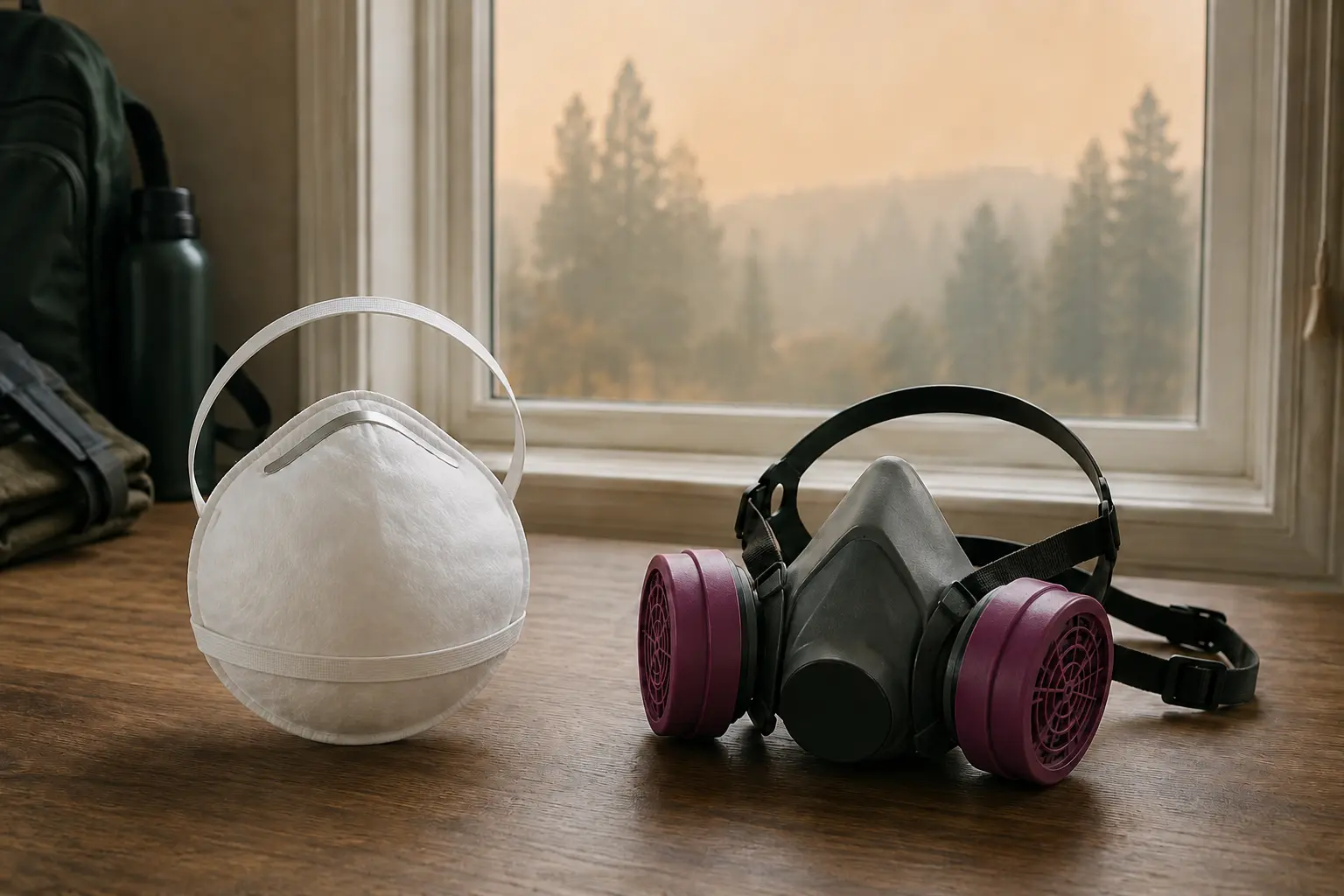
Wildfire smoke can contain high concentrations of fine particles. A genuine, correctly fitted particulate respirator can reduce the particles a wearer inhales, but the approval, fit and limitations matter more than the product’s appearance or marketing. This guide explains how to compare N95, P100 and reusable options without treating any mask as permission to remain in danger.
The short answer
- For many adults exposed to wildfire particles, a genuine NIOSH-approved N95 respirator is a practical starting point when it fits correctly.
- A P100 filter provides a higher laboratory filtration class but can be heavier, more expensive or harder to breathe through depending on the design.
- Reusable elastomeric respirators can provide strong seals and replaceable filters, but require correct sizing, cleaning, storage and valve inspection.
- Particulate respirators do not protect against carbon monoxide, oxygen deficiency or every gas and vapour in smoke.
- Evacuation orders, clean indoor air and reducing exposure take priority over relying on a respirator.
N95, P100 and reusable respirators compared
| Type | What the rating means | Useful characteristics | Main limitations |
|---|---|---|---|
| Disposable N95 | NIOSH N-series filter with at least 95% filtration efficiency under its approval test | Light, widely available and practical for short-term household preparedness | Fit varies by face; not oil-resistant; normally discarded when damaged, soiled or difficult to breathe through |
| Disposable P100 | NIOSH P-series filter with at least 99.97% filtration efficiency under its approval test | Higher filter class and oil-resistant designation | May cost more and does not solve poor fit, gases, carbon monoxide or unknown atmospheres |
| Elastomeric half-mask with P100 filters | Reusable facepiece using replaceable approved filters | Durable seal, replaceable components and multiple sizes on many models | Requires maintenance, cleaning, valve checks, correct cartridge selection and organised storage |
| European FFP2 or FFP3 | European approval categories with their own test and marking requirements | Relevant options in European markets when genuine and correctly fitted | Approval systems and markings are not interchangeable; verify the standard required in your location |
What an N95 can—and cannot—do during wildfire smoke
An approved N95 is designed to filter airborne particles when worn correctly. It can reduce exposure to fine smoke particles, including part of the PM2.5 fraction, but it does not make polluted air safe. Leakage around the face can dominate real performance.
An N95 does not provide oxygen, does not protect against carbon monoxide and is not designed for firefighting, flame exposure or entry into an unknown or immediately dangerous atmosphere. If authorities advise evacuation or conditions are unsafe, leave rather than relying on respiratory protection.
Approval and authenticity: verify before buying
In the United States, “N95” is a NIOSH approval designation, not a generic shape. Check the required markings on the respirator or filter, the approval number and the manufacturer’s listing in the NIOSH Certified Equipment List. Packaging, marketplace titles and a printed “N95” alone are not sufficient evidence.
- Buy from the manufacturer or a traceable authorised seller where possible.
- Compare the model, approval number, filter class and manufacturer name with the official listing.
- Avoid products with missing markings, implausible claims, poor documentation or inconsistent packaging.
- Check safety alerts and recalls for the exact model.
- For non-U.S. products, verify the relevant national or regional approval system rather than assuming equivalence.
Fit is as important as filtration
Air follows the easiest path. If the face seal leaks, smoke particles can bypass the filter. Different face shapes need different respirator shapes and sizes, so no single model can be declared “best fitting” for everyone.
- Follow the manufacturer’s donning instructions every time.
- Perform the specified user seal check each time the respirator is worn.
- Make sure straps are positioned correctly and the nose area is formed as instructed.
- Facial hair, jewellery, hair or clothing crossing the seal can reduce protection.
- Discard a disposable respirator that is damaged, deformed, visibly soiled or no longer seals properly.
Workplace respiratory-protection programmes can require medical evaluation, training and formal fit testing. Household use does not recreate an occupational programme, but the same physical principle remains: a high-rated filter cannot compensate for a poor seal.
Headbands, ear loops and valves
Do not approve or reject a respirator from one feature alone. Verify the complete approved model.
- Headbands: can distribute tension around the head and are common on approved filtering facepiece respirators.
- Ear loops: may be convenient, but the exact product still needs verifiable approval and an adequate face seal.
- Exhalation valves: may reduce heat and moisture for the wearer. They do not improve inhaled-air filtration and may not provide source control for air exhaled by the wearer.
- Fold-flat or cup style: both can work when the exact model is approved, undamaged and suitable for the wearer’s face.
When a reusable elastomeric respirator may make sense
A reusable half-mask can be useful for repeated seasonal exposure, property cleanup or households that can maintain the equipment correctly. Compare:
- Available facepiece sizes and access to fit testing where required.
- Exact approved filter or cartridge combinations.
- Replacement-filter availability and cost.
- Exhalation and inhalation valve inspection.
- Cleaning method, drying time and sealed storage.
- Compatibility with goggles, hearing protection and other equipment.
Do not mix facepieces, filters or cartridges from different systems unless the manufacturer and approval explicitly permit the combination. Gas-and-vapour cartridges have specific service-life limits and are not a simple substitute for leaving a hazardous area.
Children, older adults and medical conditions
Standard occupational respirators may not fit children, and small adult models are not automatically suitable. Respirators also increase breathing resistance and can cause heat, anxiety or communication difficulties. People with heart or lung disease, pregnancy, disability or other relevant conditions should follow public-health and clinician guidance. Seek cleaner air and reduce exposure rather than depending only on a respirator.
How many respirators should a household keep?
Base the quantity on the number of intended users, likely duration, replacement conditions and local supply risk. Keep several suitable options only after confirming fit. Store them clean, dry, protected from crushing and within the manufacturer’s shelf-life conditions. Review the stock before fire season and after every use.
Buying checklist
| Check | Question to answer |
|---|---|
| Approval | Can the exact model and approval number be verified in the official database? |
| Seller | Is the supply chain traceable to the manufacturer or an authorised distributor? |
| Fit options | Are multiple shapes or sizes available for the intended users? |
| Seal | Can the wearer follow the instructions and complete the user seal check? |
| Breathing resistance | Can the intended user tolerate the device and follow medical guidance? |
| Replacement | Are filters or replacement respirators available during fire season? |
| Storage | Can the equipment remain clean, dry, undamaged and easy to reach? |
| Compatibility | Does it work with necessary goggles, glasses and other equipment without breaking the seal? |
| Instructions | Are donning, cleaning, limitations and disposal guidance clear? |
| Total cost | Have replacement filters, fit options and shelf life been included? |
Red flags when shopping online
- “N95-style”, “N95-level” or “PM2.5 mask” without verifiable approval.
- Claims of protection from all smoke, gases, carbon monoxide or fire.
- No model number, approval number, manufacturer address or instructions.
- Official-looking logos used without a matching database listing.
- One-size-fits-all claims combined with no seal-check guidance.
- Huge filtration percentages presented without naming the test standard.
Respirators are one layer of a smoke plan
Use respiratory protection alongside exposure reduction: monitor official air-quality information, close avoidable smoke entry when appropriate, create a cleaner-air room and use correctly sized filtration. The Air Purifier Buying Guide and Cleaner-Air Room CADR Calculator cover the indoor-air side of the plan.
Our independent comparison method
Tecnobosque comparisons will use verifiable approval, model traceability, fit options, breathing resistance data where available, instructions, replacement supply, storage, total cost and clearly stated limitations. A product will not rank higher merely because it pays a larger commission. Retail links may be affiliate links; see our Affiliate Disclosure.
Frequently asked questions
Is P100 always better than N95 for wildfire smoke?
P100 is a higher filter-efficiency class under NIOSH testing, but real protection still depends on approval, authenticity, fit, condition and whether the hazard is particulate. A well-fitted genuine N95 can outperform a poorly fitting P100.
Does a wet N95 filter smoke better?
No. Do not wet a disposable respirator unless its manufacturer explicitly instructs it. Moisture can damage the product, affect breathing and invalidate intended performance.
Can I wash and reuse a disposable N95?
Do not wash a disposable N95. Follow the manufacturer’s reuse and replacement instructions and replace it when damaged, soiled, difficult to breathe through or unable to seal.
Will an N95 protect me inside a burning building?
No. It is not firefighting equipment and does not protect against heat, flame, oxygen deficiency, carbon monoxide or unknown toxic atmospheres.
Official references
Follow evacuation orders, local public-health guidance and the manufacturer’s instructions. This page supports preparedness and product comparison; it does not provide medical, occupational-safety or firefighting advice.